I make films and build the workflows behind them. From image and video generation to performance, editing and dedicated creative tools, I work hands-on to turn a creative idea into something that holds attention.
I composed the production pipeline and personally generated most of the film’s video. My artistic direction extended into visual development, workflow design, animation, iteration, editing and finishing.
The work meant maintaining character identity, visual continuity and cinematic intention across different models and repeated generations, then shaping those outputs into a coherent film.
Film direction, writing & art: Maya Tsarfati. Artistic direction, hands-on AI production & workflow design: Nir Sa’ar.
Read the selected-sequence transcript
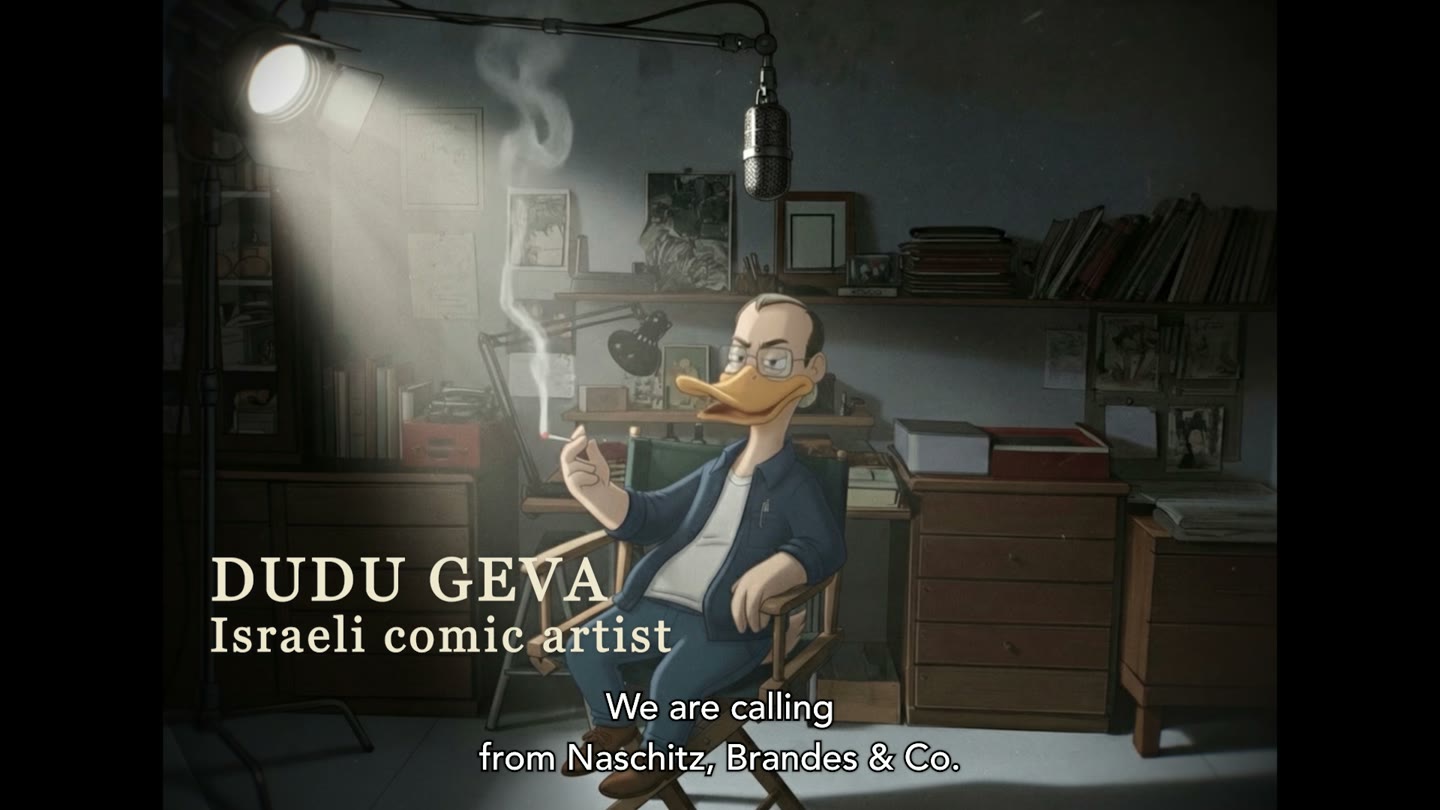
Interview performance
Ready? When did you first hear about the whole thing? They woke me at seven in the morning and said: We are calling from Naschitz, Brandes & Co. It took them half a minute just to finish all the names. Do you know you violated copyright law by using Donald Duck in your story? And what did you answer? I do not know how I managed to form an answer at that hour, but I said that Duck is a public figure, and that using him and responding to him is every artist's right. They promised I would hear from them, and hung up.
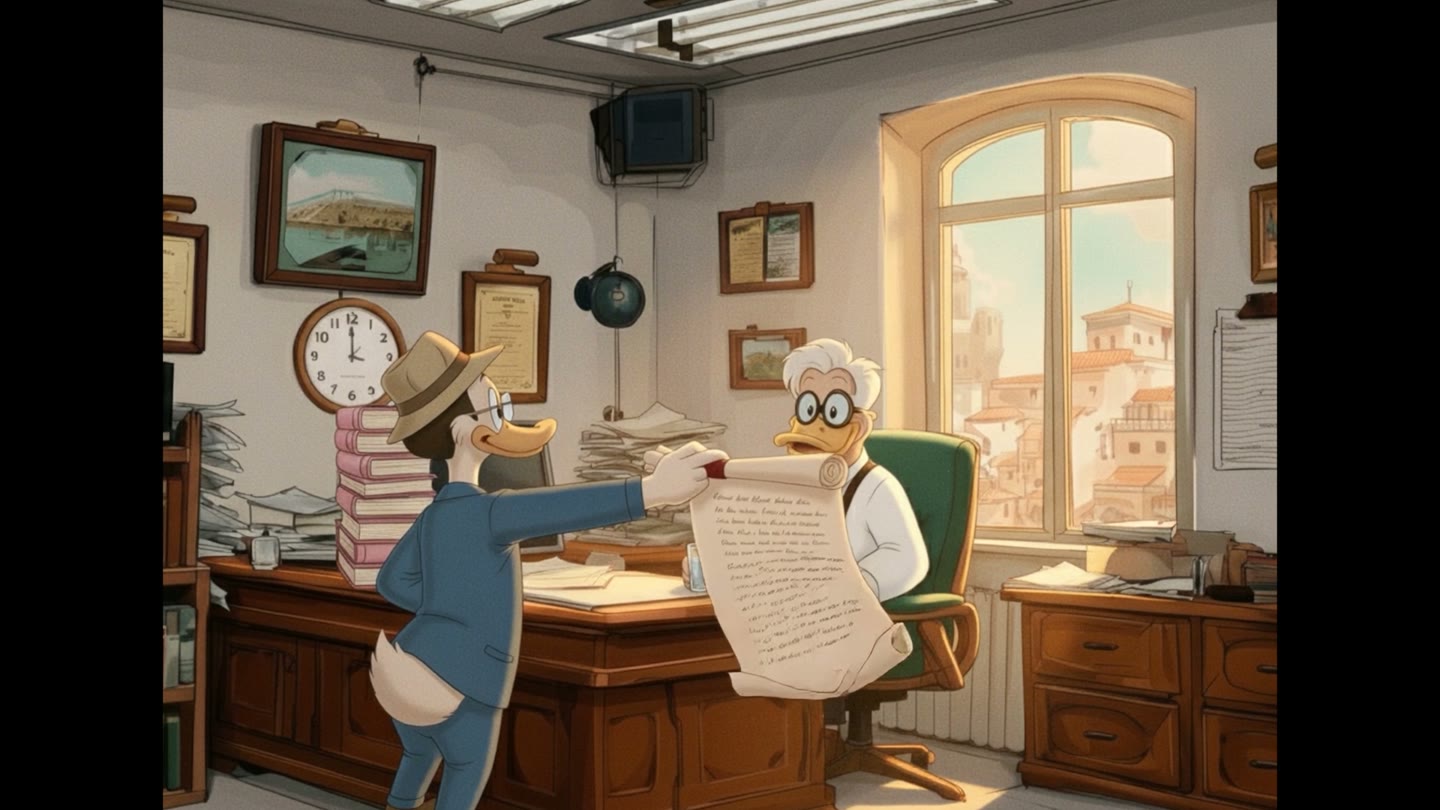
Two-character scene
"Walt Disney is after me," he said in panic. "A glass of water?" I offered. Dudu handed me the injunction with trembling hands. It turned out that Walt Disney, the darling of children, is a corporate monster, merciless, chasing to the ends of the earth anyone who tries to harm one of the thousands of characters produced by Walt Disney's workers in those crowded studios. The argument against Dudu Geva was copyright infringement, trademark infringement.
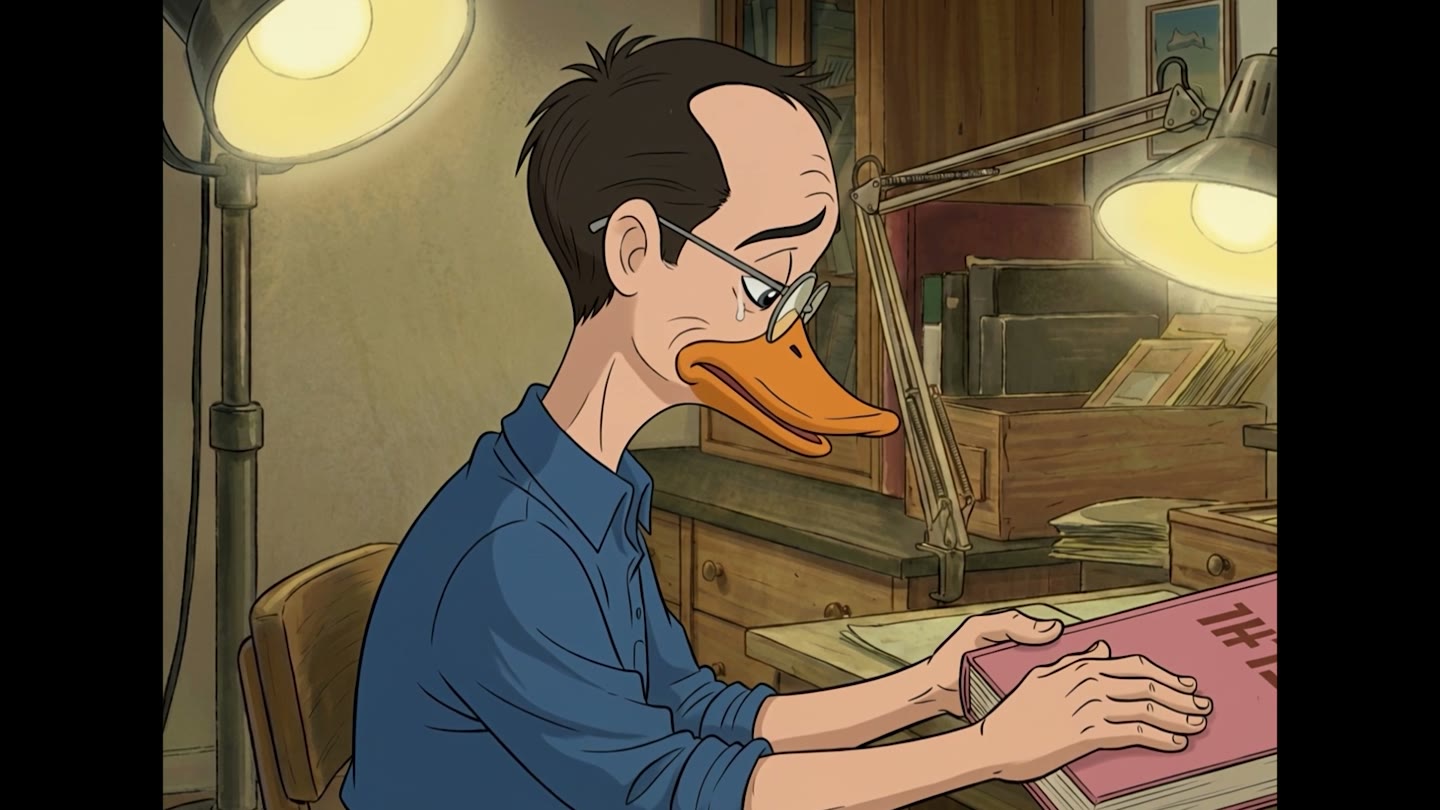
Studio & movement
There is no doubt that the Supreme Court ruling did Dudu Geva an injustice.
02 / Inside the productionReferences → generations → editorial decisions
The decisions behind the image.
Two production studies from DUCKS.
01
Character continuity
A character that survives the next shot.
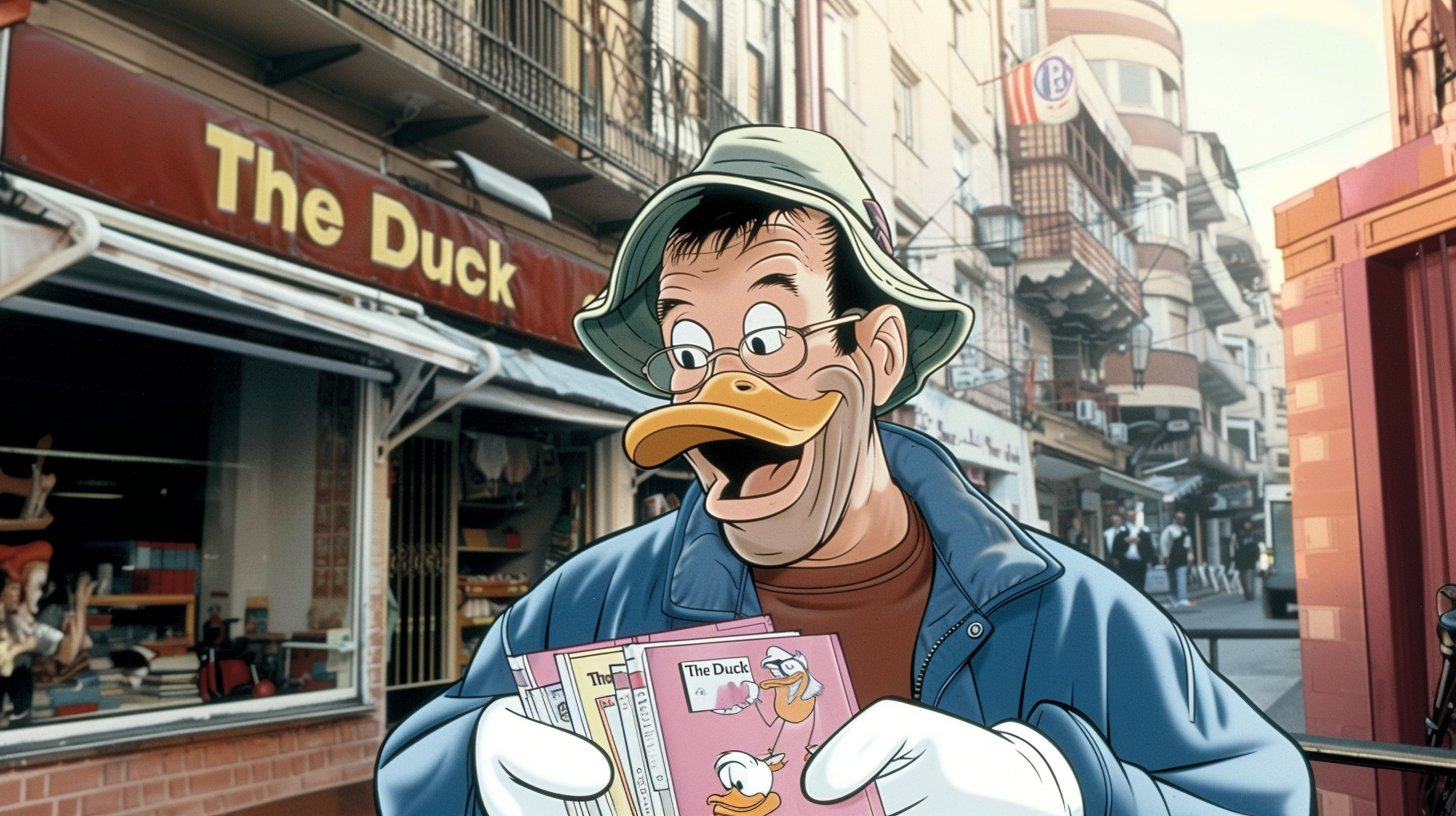
Early production referenceFrame from the completed film
An early reference establishes a visual direction. Production needs a character that remains recognisable across poses, expressions, settings and movement.
The DUCKS process used character-reference banks, multiple angles, controlled proportions and separate character/background development. Prompts specified silhouette, costume, line quality, colour and the visual traits to preserve.
The decision: build a reusable reference system, then judge each generation against the character and the scene.
These are an early production reference and a final-film frame, showing the development of the visual language.
02
Performance & control
Direct the moment. Control the frame.
Interview performance · Film frameTwo-character staging · Film frame
A shot needs intention: what the character hears, when they react, how they move and what the camera should do.
Production notes broke performance into timing and behaviour: a fixed camera, a listening beat, then an excited response. Other prompts specified a gradual camera move, nervous gestures and a deliberate pause before speech.
The decision: treat timing, gaze, gesture and camera behaviour as separate direction choices; select and finish the material in the edit.
Drawn from the project’s prompt-testing notes and saved production prompts.
03 / A repeatable methodFrom creative brief to finished work
Make the work. Make it repeatable.
A practical production structure that other people can use.
01
Define the intention
Story, audience, performance, visual language and what a successful shot needs to communicate.
02
Build the references
Character banks, style rules, environments, shot plans and the details that must remain consistent.
03
Generate & evaluate
Compare models, iterate on behaviour and motion, and select outputs against the creative brief.
04
Finish & hand over
Edit, composite, sound and colour, with organised prompts, references and review criteria for reuse.
Creative judgment & responsible production
My approach starts with the source material: establish permissions and consent for imagery, likeness and voice; keep a record of sources and tools; make AI’s role clear; and retain human review of performance, meaning and the final release.
I use AI-assisted coding and rapid prototyping to build dedicated creative tools, structure workflows and make production choices easier to act on.
I work from the creative problem: understand the brief, test an approach, build a useful interface and refine it through use. My background in Makor Media Lab, real-time VR and international production connects this work with practical team needs.
Interactive workflow sketch
Scope a shot.
Choose a creative task. Explore a production plan and its review checks.
Your shot plan
Character performance
Review before finishing
A simplified planning demonstration built for this portfolio. It shows how a creative brief can become a usable production tool.
Founder & Artistic Director of an international XR incubator, mentoring multidisciplinary teams through concept, prototyping, production and presentation.